
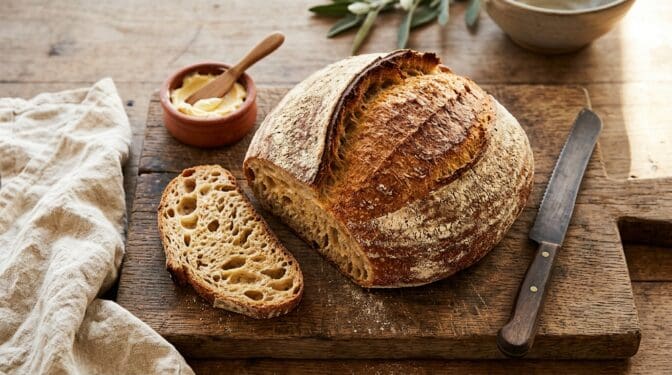
The no-knead sourdough is the bread that turned every Australian home baker into a serious baker during the 2020 lockdowns.
Why you are cooking this tonight
The no-knead sourdough is the bread that turned every Australian home baker into a serious baker during the 2020 lockdowns. It uses an active starter, four ingredients, and a cast iron pot. No kneading, no standing mixer, no scoring lessons. Fold four times over a three-hour stretch, then forget about it overnight in the fridge. In the morning it bakes at 240 in a covered pot for twenty minutes, then uncovered for another twenty-five. You end up with a loaf that looks like it came from a Melbourne bakery.
The starter is the commitment. Buy one from a bakery, borrow one from a friend, or make your own with flour and water over five days. Keep it in the fridge. Feed it the day before you bake. This recipe assumes you already have an active one.
Notes on method
Strong bread flour. Filtered water. A real Dutch oven or cast-iron casserole that holds the heat. Hot oven, lid on for the first half of the bake. The dough should sound hollow when you tap the bottom.
What to pour with it
Warm with butter, a poached egg, and a coffee. With dinner: a roast chicken and a McLaren Vale shiraz. With olives and a glass of Dal Zotto prosecco.

Dolin Dry Vermouth de Chambery
Cold vermouth, sourdough, butter, salt. Twenty-second pre-dinner ritual.
Read more →

The recipe
Ingredients
Method
- Combine starter, water, flour and salt in a large bowl. Mix with your hand until no dry flour remains, 2 minutes. Cover, rest 30 min.
- First fold: wet your hand, grab an edge of the dough, stretch it up and fold over. Rotate bowl a quarter turn. Repeat 3 times. Cover, rest 30 min.
- Do 3 more rounds of folds, 30 min apart. The dough should feel stronger each time.
- Bulk ferment another 2-3 hours at room temp (total 4-5h from mixing). Dough should be puffy and jiggly but not doubled.
- Turn dough onto a lightly floured bench. Fold top down, bottom up, sides in. Flip seam-down. Shape into a tight round by rotating with the sides of your hands.
- Place seam-up in a floured banneton or a bowl lined with a floured tea towel. Cover. Refrigerate 12-18 hours.
- Put a cast-iron Dutch oven in the oven. Preheat to 240°C fan-forced for at least 45 min.
- Turn dough out onto baking paper. Score the top with a blade or sharp knife. Carefully lift paper and dough into the hot pot.
- Cover, bake 20 min. Remove lid, reduce to 220°C, bake another 20-25 min until deep brown and hollow-sounding when tapped.
- Cool on a wire rack at least 45 min before slicing.
Two things that go wrong
Your starter wasn’t active enough.
Sourdough only rises with a starter that doubles in 4-6 hours after a feed. If you mixed dough with a starter that just woke up from the fridge and hadn’t peaked yet, you’ll get a brick. Feed the starter the night before and watch it rise; only mix when it’s at peak height.
You didn’t preheat the Dutch oven hot enough.
Lukewarm cast iron gives you a pale, sad loaf that doesn’t spring. The pot needs to sit at 240°C for at least 45 minutes before the dough goes in. The first hit of steam from the cold dough against the screaming hot pan is what creates the bloom.
Variations worth knowing
Whole grain
Replace 100g of the bread flour with whole wheat or rye. Adds nutty depth and a darker crumb. Hydration may need a 5% bump.
Olive and rosemary
Fold 80g pitted Sicilian olives and a tablespoon of fresh rosemary into the dough during the second fold. Don’t over-mix or you’ll bruise the olives.
Seeded crust
Brush the loaf with water before baking and roll it in a tray of mixed sesame, poppy and sunflower seeds. Bake as normal.
Leftovers and make ahead
Day-old sourdough is better than fresh for a lot of things. Toast and eat with butter and Vegemite for breakfast. Slice thick and grill for bruschetta. Tear into croutons for a Caesar salad. Or rip into chunks, soak in tomato and olive oil, and call it ribollita. Sourdough doesn’t go stale, it gets useful.
You might also like

Recipe
The Proper Aussie Beetroot Burger
Why you should cook this The Aussie burger is the only burger format that openly admits to being a structural disaster. Beef pattie, melted tasty cheese, fried egg,…
Read the recipe →
Recipe
Pork & Cabbage Dim Sims (Aussie Style)
The Australian-Chinese fish-and-chip-shop dim sim. Why you should cook this Dim sims are the Australian-Chinese fish-and-chip-shop classic that nobody outside Australia has heard of and that everyone inside…
Read the recipe →
Recipe · Baking
Vegemite & Cheese Scrolls
Why you should cook this The lunchbox classic that you remember as the highlight of grade four and that, when you make them yourself as an adult, you…
Read the recipe →
Recipe
Savoury Cheese & Bacon Muffins
School lunchbox classic, grown-up version. Why you should cook this The lunchbox muffin that actually holds together. Cheddar, crispy bacon, spring onion, a fold of self-raising and a…
Read the recipe →